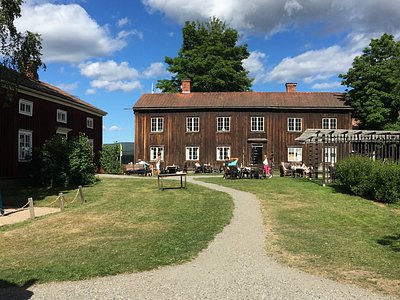
Welcome to Arbrå, Sweden. It is here that Corine Noren was born on the out skirts of Arbrå. A little east of town center. The Local area was known as "Koldamo". Arbrå itself is located about 15 Km (about 9.3 miles) north of Ballnas, and 5 Km (about 3.1 miles) south of Vallsta, along the Ljusnan River. Her home was an old, rather large structure. Probably built by her grandfather. And each succeeding generation lived in it. As was the custom in those times (17th to 18th century). And, "not migrating, hither and thither, as was done in the large cities", (as was quoted by my great-grandmother). The homestead was near a large wood. With a small inland lake and wood.

Arbrå, Sweden
Corine's mother, Gölin Pehrsdotter, died when Corine was about a year old. Corine was the youngest of 3 sisters. Of necessity, it was not long before there was a stepmother installed in the house. Corine's stepmother's name was Stina Sjon Andersdotter. After which there came several more childres. Her stepmother was a good and kind mother to all the chrildren. And there was no cause for complaint from the older children.
Karin's father was an intellectual man. He became a lay preacher. Starting a church, later to be nown as the Swedish Covenant Church. And had studied a great deal and wrote considerably. He and several of his parishioners erected a church for the town. Corine's father, Pehr Noren passed away when Karin was about 14 years old. From Arbrå. Corine traveled to Hudiksvall. Presumably to learn a trade. (she was trained to be a seamstress). This is where she might have met Nils Peter (my great-grandfather). They were both in Hudiksvall durning the same period.
Corine Norén migrated to America in early May of 1892. She left from Göteborg, the same as Nils. She traveled on the SS Norden. Which took her to her first stop, Humburg, Germany. From Humburg she traveled by train to Breman. And from Breman, she boarded the SS Trave, a steamer that would take her to New York City, America. Upon her arrival she set off immediately for Du Bois Penn. And there she met up with Peter. And within several days of her arrival she was married. That would have been on the 25th of May 1892.
Arbrå, located in Hälsingland, Sweden, was part of a broader regional pattern of emigration during the 19th and early 20th centuries. While Arbrå itself may not be widely documented in emigration studies, it fits into the larger story of rural Swedish communities sending thousands to North America.
🌍Why People Left Arbrå and Similar Areas Economic hardship: Crop failures, limited farmland, and industrialization displaced many rural workers. Religious and social pressures: The dominance of the Lutheran State Church and rigid class structures pushed people to seek freedom elsewhere. Population growth: Sweden’s population doubled between 1750 and 1850, straining resources.
🚢 The Journey to America Most emigrants from Arbrå would have traveled to Gothenburg, then taken a feeder ship to Hull, England, followed by a train to Liverpool, and finally boarded a transatlantic liner to the U.S. The trip could take 10–20 days, often in cramped steerage conditions.📍 Where They Settled. Many Swedes from Hälsingland ended up in Minnesota, Illinois, and Wisconsin, drawn by farming opportunities and established Swedish communities3. Some moved to urban centers like Chicago, working in construction or domestic service.